Why this drive exists at all
Jeddah has the country's second international airport and is the standard arrival point for the west coast and for AlUla. That is the whole reason the route matters: people land on the Red Sea, and the valley they came for is inland.
AlUla is a sandstone valley that was farmed and settled for thousands of years because it has water, and it sat on the incense road running north out of southern Arabia. That history left four distinct sites within a short drive of each other: the Nabataean tombs at Hegra, the cliff-cut capital at Dadan, the inscription canyon at Jabal Ikmah, and the mud-brick Old Town.
Book Hegra before you set off
This is the thing that catches people out, and it cannot be fixed once you have arrived. Hegra is not a site you wander into. Access is by guided tour with an AlUla Rawi, the local storyteller-guides, travelling between the tomb clusters by vehicle, and tour numbers are limited each day. Pre-booking is recommended, and it needs to happen before you travel rather than on the morning. A guided day at Hegra is how we hold that slot for people making the drive.
Straight through, or break the journey
AlUla lies in Madinah Province, and Madinah has an international airport and sits on the Haramain high-speed line to Jeddah. That gives the trip a second possible shape: rail or road to Madinah first, a night there, then the road on into the valley.
| Option | Suits | Settle first |
|---|---|---|
| Private car and driver, straight through | Travellers whose trip is about the valley and nothing else | The Hegra tour slot, and an early start |
| Break the journey at Madinah | Anyone who wants the Hejaz as well as the tombs | Who in the party can enter which sites in Madinah |
The direct version is Jeddah and AlUla. If the Madinah stop appeals, Jeddah and Madinah shows what the city is worth on its own before you carry on north.
When to make the drive
October to March is the workable window for AlUla, and summer in the valley is severe. The same sun sits on the road. If your dates are movable rather than fixed, the cooler months settle the question for you; the best time of year to visit AlUla goes through the seasons in detail.
What is waiting at the other end
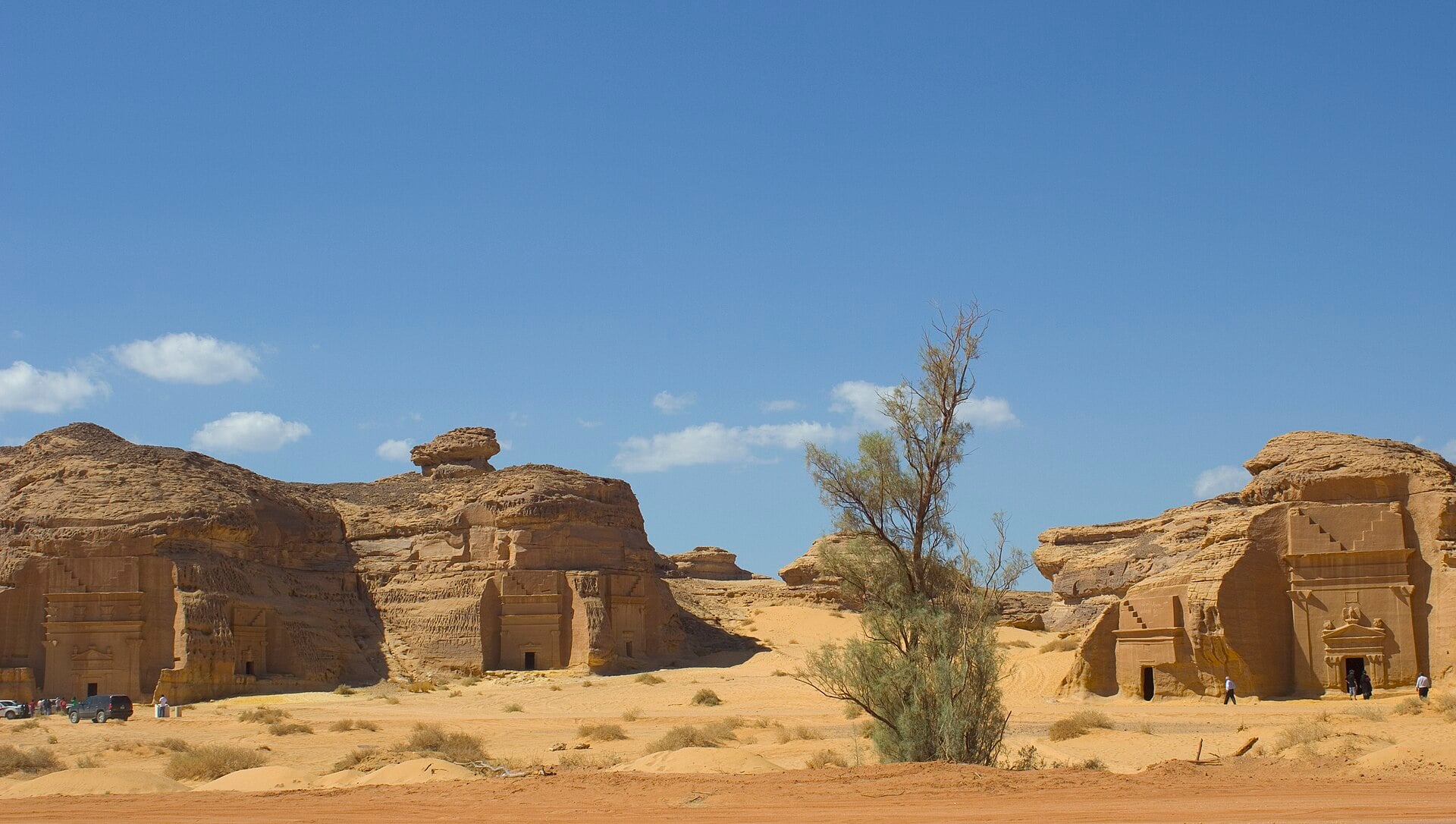
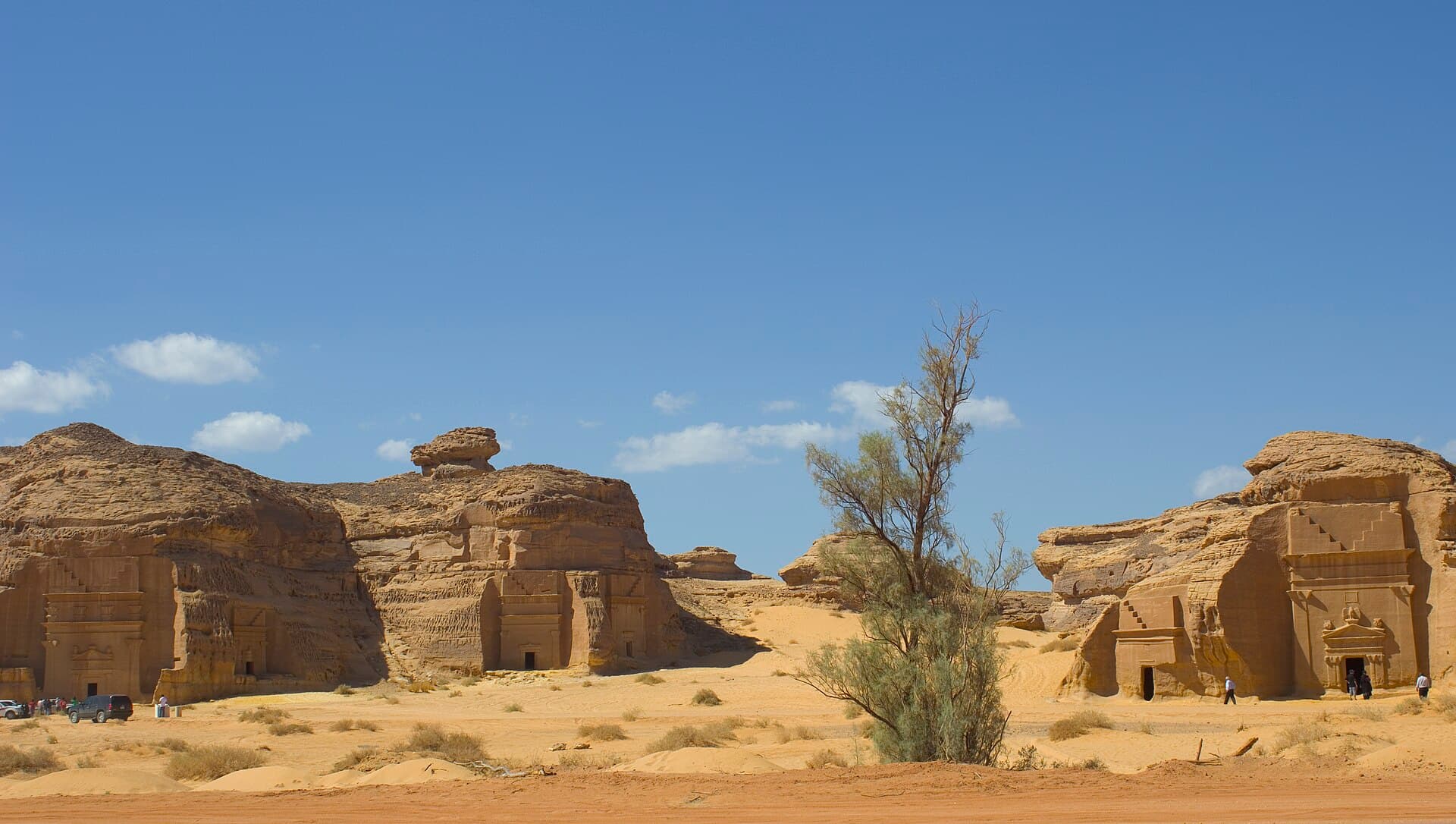
Hegra is the largest surviving Nabataean city after Petra and the first place in Saudi Arabia to be inscribed on the UNESCO World Heritage List. More than 110 tombs are cut into sandstone outcrops scattered across the desert floor, their facades carved directly into the rock, and some chambers carry inscriptions describing the person laid inside. One burial has a name attached: Hinat was excavated in 2008, and the reconstruction of her face is shown at the Hegra Visitor Centre.
Dadan was the capital of the Dadanite and Lihyanite kingdoms, its tombs cut almost 50 metres up the cliff wall above the oasis, two of them guarded by carved lions. Jabal Ikmah is a desert canyon whose walls carry hundreds of pre-Arabic inscriptions, and it is worth being precise about its status: it was added to UNESCO's Memory of the World Register, which recognises documentary heritage and is a different list from the World Heritage List. Elephant Rock is a 52-metre sandstone outcrop weathered into the shape of an elephant with its trunk to the ground, and there is no ticket. AlUla Old Town is a labyrinth of mud-brick houses built from the 12th century, walled with fourteen gates and overlooked by a fort standing 45 metres above it.
Getting between all of that once you arrive is its own question, and getting to and around AlUla covers it.
Give Jeddah a morning first
Historic Jeddah, known locally as Al-Balad, has been on the World Heritage List since 2014. The city has been a major Indian Ocean port since the 7th century AD and the point at which pilgrims arrived for Makkah by sea, and that double role paid for the quarter that survives: tower houses of coral stone, faced in the carved wooden bay windows called roshan. A good part of the quarter is propped and under restoration, so it is a working site rather than a finished one. Jeddah: a first-timer’s guide sets out what to do with the hours before departure.
Routes that use the same road and keep going
The drive north does not have to end in the valley. Jeddah, AlUla and Tabuk carries on into the far north-west, where the country turns to sandstone desert, the Hejaz Railway and the canyon country running toward the Jordanian border. It is the same road for the first stretch, used for more.