What Dadan was
Dadan was the capital of the Dadanite and Lihyanite kingdoms, and it stands carved into the cliff face above the AlUla oasis. The kingdoms based here controlled the oasis and the trade moving through it for centuries before the Nabataeans arrived at Hegra, a short drive north, which makes Dadan the older of the two archaeological layers in the valley.
The city sat on the Incense Road, and it was one of the discoveries that made the wider archaeological community take AlUla seriously. Excavation is ongoing and a good deal of the site is still unread, so what is on show is a working dig rather than a finished monument.
What you see
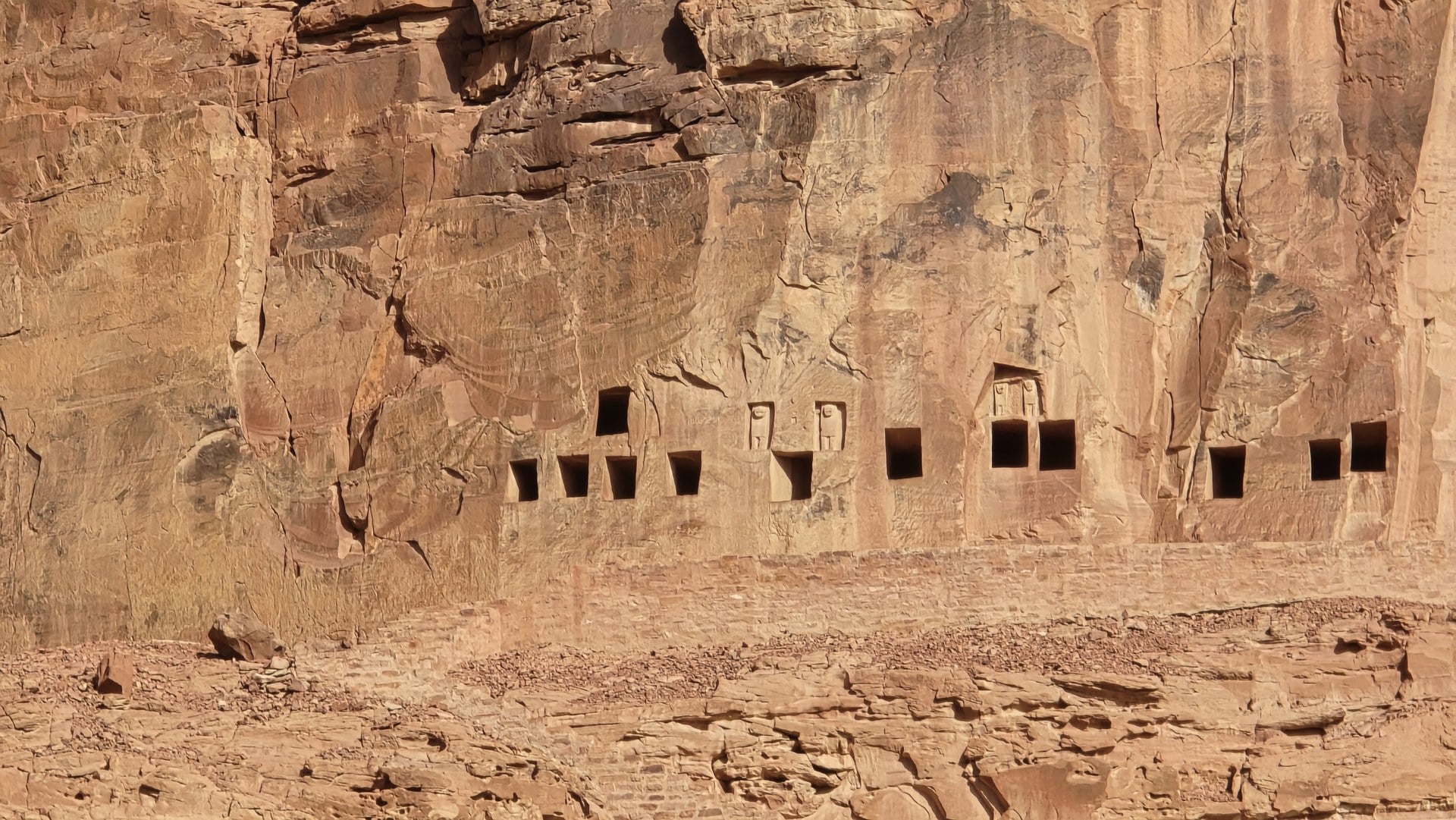
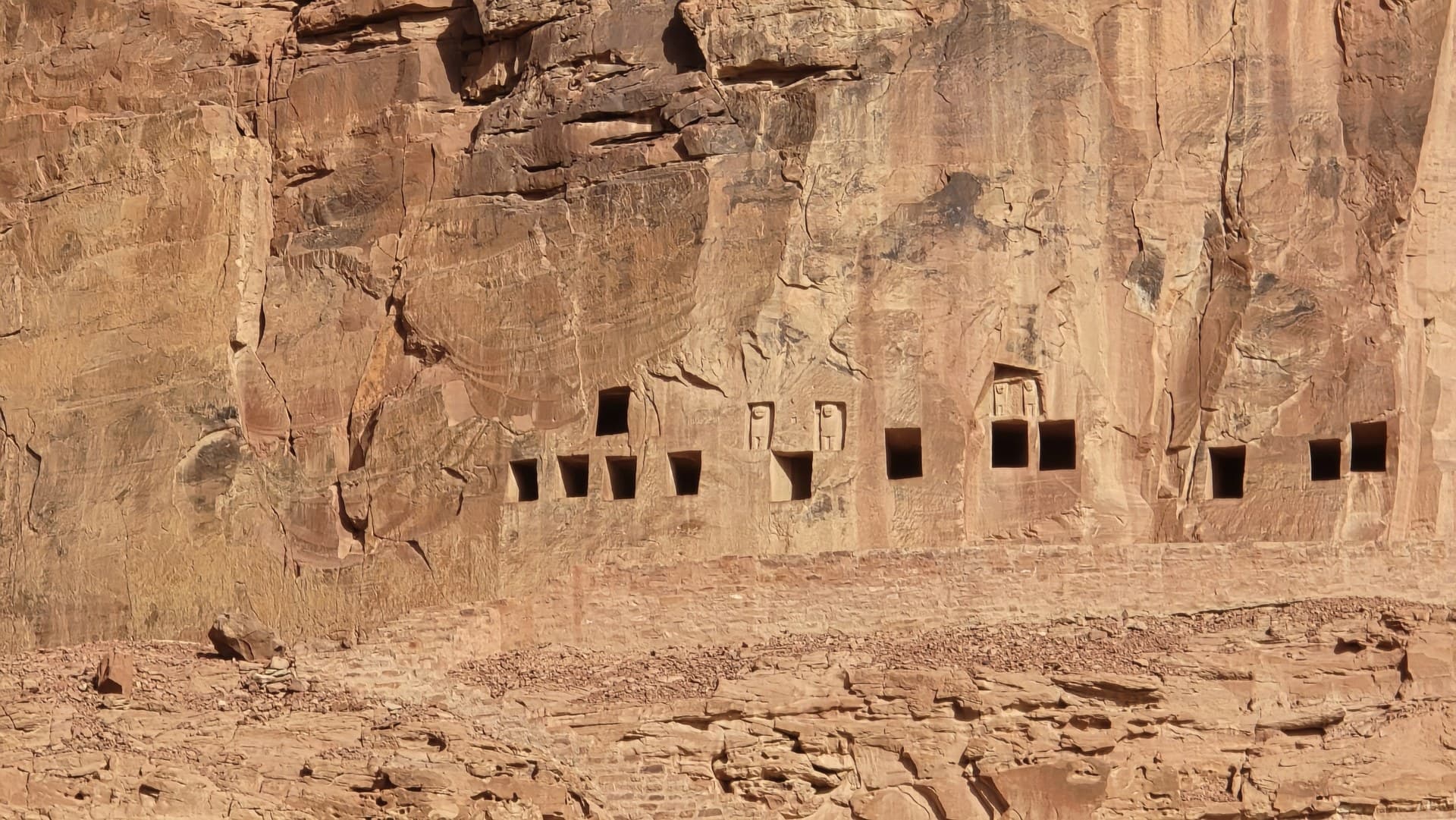
The tombs sit almost 50 metres up the rock wall, cut as square openings in a line across the cliff. Two of them are guarded by carved lions. From the valley floor they read as a row of dark squares in red stone, and the scale only registers when you notice how small the people standing below them look.
Alongside the tombs the site holds inscriptions and cut architecture at ground level, the remains of the settlement that the cliff burials belonged to. Our Dadan page goes through the layout in more detail.
The cliff face gives you a row of openings and two lions; who was buried there and why is carried by whoever is explaining it. That is worth knowing before deciding whether to drive out alone.
Dadan, Hegra and Jabal Ikmah are three different things
Travel writing tends to blur AlUla's ancient sites into a single word. They are separate places, built by different people, and worth telling apart before you plan your days.
| Site | Who built it | What survives |
|---|---|---|
| Dadan | The Dadanite and Lihyanite kingdoms, more than 2,000 years ago | Tombs cut almost 50 metres up a cliff, two with carved lions |
| Hegra | The Nabataeans, as their southern capital | More than 110 rock-cut tombs standing on the valley floor |
| Jabal Ikmah | Generations of writers in several scripts | Hundreds of inscriptions along a canyon |
If you only read one more of these guides, make it Hegra: what to expect and how to visit, because Hegra is the site with the tightest access rules and the one you are most likely to have to book around. Jabal Ikmah: what to expect and how to visit explains the canyon that is presented as a pair with Dadan by the tourism authority.
How to visit
Dadan and Jabal Ikmah are close together, and the tourism authority presents them as a pair. Dadan and Jabal Ikmah does exactly that, with a driver, a guide and hotel pick-up, which removes the problem of getting between two sites that are not on a public route.
The viewing is from the valley floor rather than up at the tombs themselves, so the walking is undemanding. What changes the visit is having someone explain what the carved openings and the lions are for.
When to go
October to March is the workable window in AlUla, and summer in the valley is severe. The site is open ground below an exposed cliff, so the difference between a March morning and a July one is not a matter of comfort but of whether the visit is sensible at all.
The other thing the season decides is how much of the valley you can string together in a day. Most AlUla sites are visited by guided tour with transport included, and in the cooler months a morning at Dadan and the inscription canyon leaves the afternoon and evening open rather than spending them recovering.
Fitting it into a trip
Dadan rarely drives an itinerary on its own. It works as the second or third stop in a valley that also holds Hegra, the inscription canyon and AlUla Old Town, whose restored lane of shops and restaurants gives AlUla its one genuine evening.
Across a longer route, Jeddah, AlUla & Tabuk runs from the Red Sea coast up into the north-west and takes in the valley on the way, while Riyadh, AlUla, Madinah & Jeddah treats AlUla as one leg of a broader loop through the capital, Madinah and Jeddah. For deciding what else in the valley earns a slot, Things to do in AlUla lists the options, and AlUla: a first-timer's guide is the place to start if this is your first trip to the country.